Useful first · personal forever
The object
we build together.
A home can be furnished by choosing. It becomes ours through something we make. The first family object for 168 should not shout across the room; it should quietly earn its place every day.
The idea
Not another accessory. A small piece of family history.
The most meaningful object in a serious room does not have to be the most expensive. It can be the thing everyone remembers building: measured at the dining table, argued over, rebuilt, and finally placed where it belongs.
LEGO® bricks give the project a useful tension. From a distance, the object can read as a calm architectural volume. Up close, the joins reveal play, patience and the hands that made it.
Let the bricks carry the story—not the risk.
Three candidates
The first object has to earn the first chapter.
We judged each idea by usefulness, visual calm, family participation, maintenance and what happens if one connection fails. That points to a deliberately modest beginning.
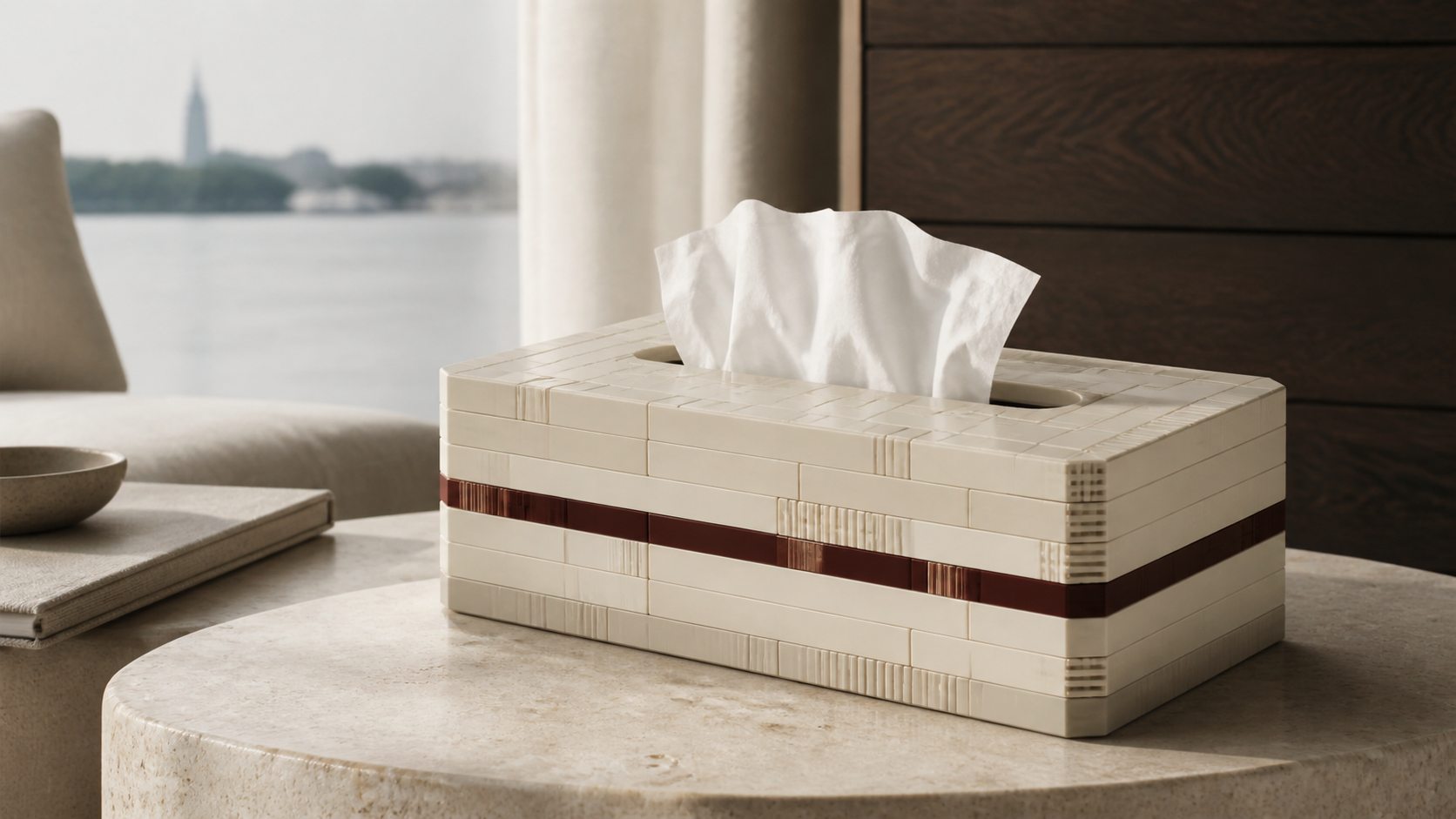
Tissue-box sleeve
Used every day, dry, low-load and easy to refill. The commercial carton keeps its hygienic job; the removable shell carries the design and the memory.
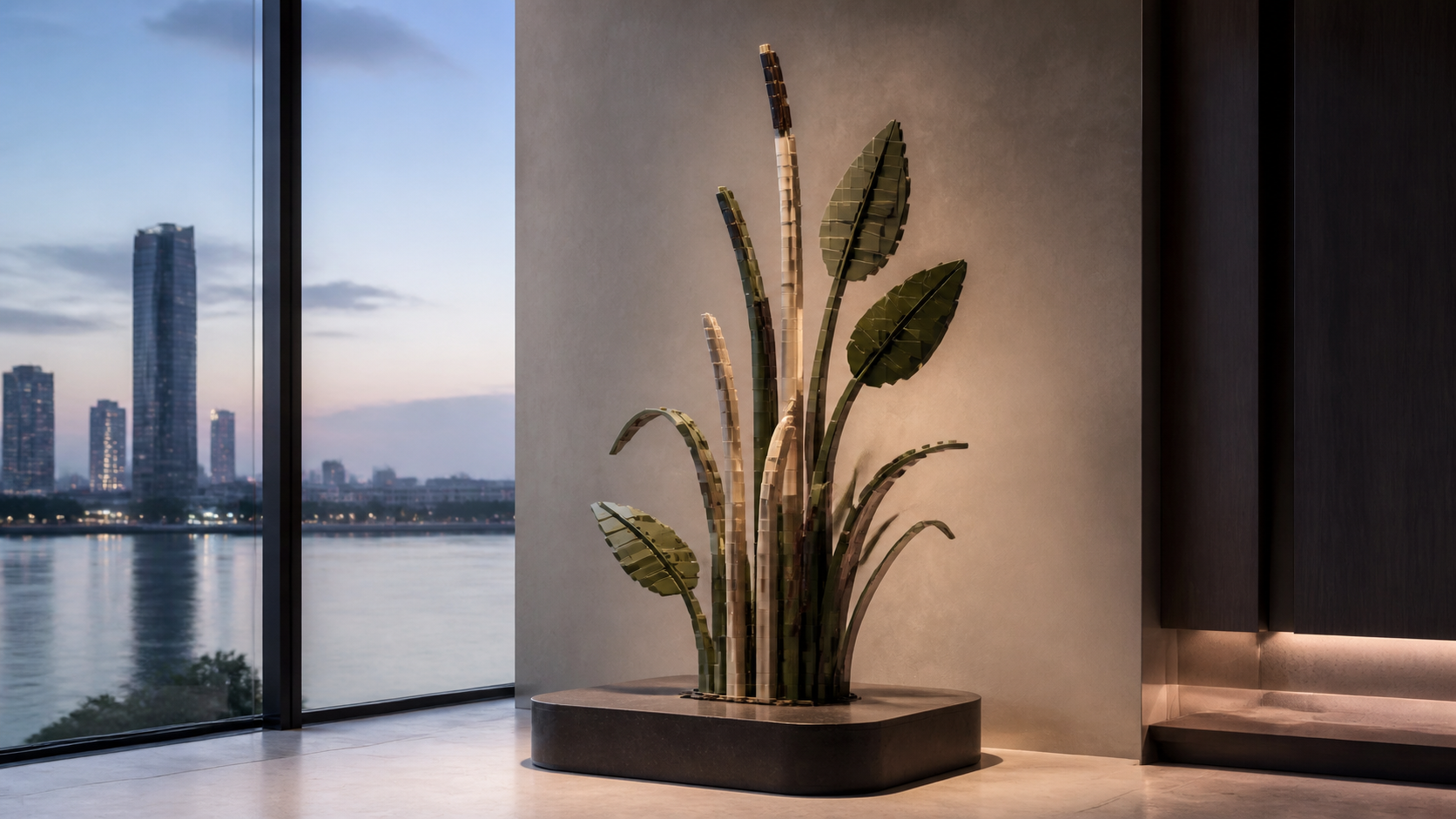
River Reeds sculpture
A stronger signature for the corner, but also taller, dustier and more demanding to stabilise. It deserves a separate prototype after the family completes the first object.
Valet caddy
A modular home for remotes, keys and small daily objects. Useful and feasible—provided the brickwork remains a decorative frame around a replaceable liner.
Prototype 01
A quiet shell around an ordinary box.
The form is a removable sleeve, not a tissue container. A standard sealed carton slips inside from below; a broad, smooth opening avoids snagging. No glue. No hidden mechanism. The first model is made to be taken apart and improved.
The family ritual
Design together. Order once. Revise with evidence.
- 01
Measure what is real
Choose the tissue brand first. Measure the actual carton and make a full-size paper envelope before deciding dimensions or buying a single element.
- 02
Give everyone one move
Each person chooses one hidden brick or proposes one rule. The exterior stays calm; the private layer records who made it.
- 03
Build the rough version
Use available pieces first. Test the pull opening, corner strength, refill access and the way the sleeve sits on the intended surface.
- 04
Freeze the digital model
Rebuild the winning prototype in BrickLink Studio, keep collision checking on, reduce rare pieces and create the working bill of materials.
- 05
Verify sourcing
Parts and colours change by market. Thailand is not on LEGO.com’s current direct-shipping list, so availability must be checked at the actual supported destination or from owner-verified local stock before any order.
- 06
Live with it
Photograph the family build, date a hidden interior tile, use the object for 30 days, then allow one final revision before it becomes part of the home.
Prototype 02 · later
The corner can become a living sculpture—without becoming a planter.
The larger idea is a dry botanical composition: abstract reeds and leaves built in modules, rising from a broad, independently weighted plinth. It uses no water, carries no electrical component and depends on a real anti-tip review before entering the room.
This is the sequel because scale magnifies everything: beauty, dust, sourcing, connection strength and risk. The family should learn the material at the scale of a tissue box first.
Keep the play. Remove the hazard.
Where the brickwork stops.
- Dry objects onlyNo unlined planter, aquarium use or cavity that can trap water.
- No heat or flameNo candleholder, incense base, lamp enclosure or placement in direct tropical sun.
- No structural dutyNo stool, shelf, overhead piece or object expected to carry a person, books or heavy loads.
- No food contactUse a removable, purpose-made liner whenever an object holds something that touches the body or food.
- Small-parts disciplineAge-appropriate participation, adult supervision and no loose elements around children under three.
- Care by disassemblyHand-clean gently below 40°C, dry fully, inspect loose parts and rebuild—never glue the prototype shut.
What ownership feels like
The room will be designed by many people. This object can belong only to this family.
That is the real luxury in the project: not an object that looks expensive, but an ordinary need turned into a shared memory. If Prototype 01 earns its place, 168 gains something no catalogue can supply.
Method, sources & limits
A design proposal, not a finished object.
The two images are AI-assisted original 168 concept illustrations. They do not prove buildability, stability, part availability, dimensions or the appearance of a completed family build. A physical prototype, child-safety review, source check and intended-location test must come first.
The working colour ratios are art direction, not a promise that every element exists in every colour. No parts have been ordered, no retailer has been contacted and no buying recommendation is made here.
Official references
- Pick a Brick — individual-element search and list-upload capability; stock and limits vary by market.
- LEGO.com shipping regions — Thailand was absent when checked on 23 August 2026.
- BrickLink Studio — digital modelling, instructions and bill-of-materials workflow.
- Cleaning guidance, water guidance and glue guidance.
- Product safety — testing of LEGO products as sold does not certify a family-designed household fitting.
- Fair Play — trademark and independent-use guidance.
Independence & rights
LEGO® is a trademark of the LEGO Group of companies which does not sponsor, authorize or endorse this site. No LEGO logo, official product photography or instructions are reproduced. Official pages are linked for factual reference; public availability is not reuse permission.