Rama IX · Thotsamarachan · claim audit
Two bridges.
One crossing.
From the riverbank, they read as a pair. Up close, they are a conversation across generations: one introduced cable-stayed engineering to Thailand; the other reworks the same 450-metre span for eight lanes, two cable planes and continuous structural monitoring. We tested the “double bridges” story—and found something rarer than a superlative.
The claim check
Distinctive, yes. Exclusive, no.
One River's official “Unique Point” visual says the Rama III riverfront comes with a view of “parallel bridges of two reigns.” That description is real. We found no primary developer statement proving that One River is the only place that can see them—and an independent review of another Rama III condominium explicitly describes views of both bridges.
Two separate parallel cable-stayed bridges.
They share a 450-metre main span and sit only 7.26 metres apart between decks.
Two generations in one composition.
Park canopy, open water and the paired silhouettes make a powerful One River context story.
“The only double-bridge view.”
Other buildings and public viewpoints can see the pair. Exact visibility from any residence also requires fixed-station evidence.
The structures themselves
Three records. Three scales of seeing.
The current pair from the public park, the new bridge at close range, and the mass opening of Rama IX in 1987. These documentary views anchor the article before any diagram or interpretation.
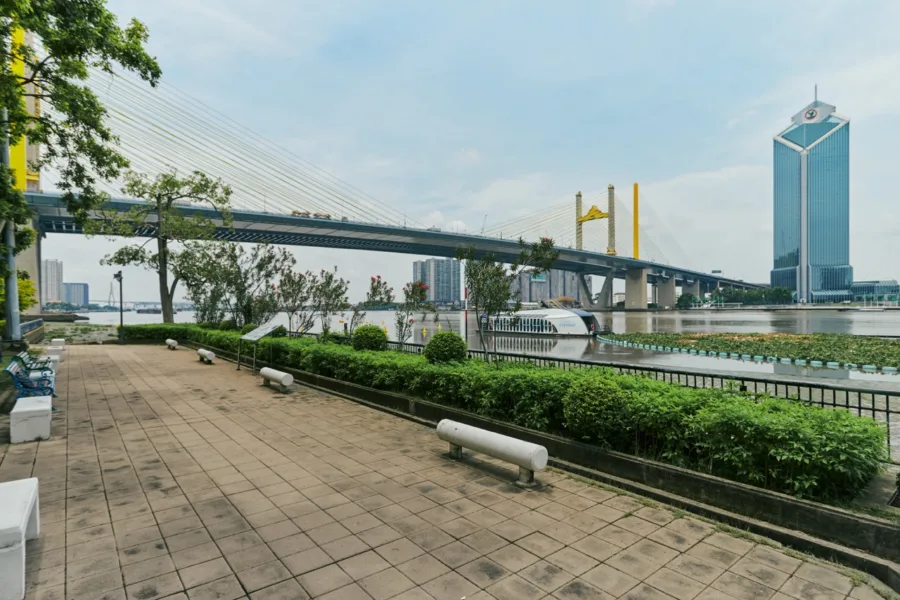


Documentary photographs · remotely loaded from the BMA park record and Thai PBS history · not owned by 168 · no public reuse licence identified.
Two public beginnings
Nearly four decades apart.
The ceremonies and traffic dates are different events. The newer bridge was royally opened in December 2024 and opened all eight traffic lanes on 29 January 2025; the full 18.7-kilometre expressway corridor was not thereby complete.
Rama IX construction begins
Thailand's first cable-stayed bridge takes shape across the Chao Phraya.
A mass public run
The bridge becomes civic theatre before road traffic begins.
Rama IX enters service
Six lanes join the expressway network.
The parallel bridge begins
More capacity—and redundancy for future maintenance—arrive beside the landmark.
Royal opening
The bridge receives its formal place in the public record.
All eight lanes open
Thotsamarachan enters traffic service between Suksawat and Bang Khlo.
Same span · different systems
They rhyme. They are not twins.
The visual relationship comes from a shared 450-metre main span. Almost every other engineering choice reflects a different era.
- Width
- 33 m
- Traffic
- 6 lanes
- Cables
- single central plane
- Deck
- orthotropic steel
- Historical role
- Thailand's first cable-stayed bridge
- Width
- 42.4 m
- Traffic
- 8 lanes
- Cables
- two planes · 152 stays
- Deck
- steel–concrete composite
- Modern role
- monitoring and maintainable strands
The extraordinary dimension
7.26 metres.
That is the peer-reviewed distance between the two decks. It is close enough that engineers studied how the wind wake from one structure changes the forces on the other. The gap is not a marketing metaphor; it is an aerodynamic design problem.
Why build beside an icon?
The second bridge is infrastructure before it is scenery.
It relieves a heavily used river crossing, adds eight lanes between Suksawat and Bang Khlo, connects Bangkok's inner expressways with the western and southern network, and creates redundancy so Rama IX can undergo major rehabilitation without removing the crossing altogether.
That distinction matters: opening the bridge did not mean every contract in the wider Rama III–Dao Khanong–Western Outer Ring Road Expressway was complete. Bridge operation and corridor completion are separate milestones.
Name, reign and light
Two reigns—not one bridge copied twice.
Rama IX Bridge commemorates the era in which it opened. Thotsamarachan means “the tenth king”; “Rama X Bridge” is a common description, while Thotsamarachan Bridge is the formal English name displayed on the structure.
The newer bridge can use programmable gold, white, blue, pink and orange lighting, each published with symbolic meaning. That is capability, not a guaranteed nightly programme. Light, color, schedule and visibility can change.
What it means for One River
The view is shared. The composition is the story.
Bangkok owns the bridges. The public park sees them. Other residences can see them. One River's defensible distinction is not monopoly, but sequence: public canopy first, then open water, then two generations of bridge held close together.
The official project visual establishes that the developer markets this association; the current BMA park photograph establishes the pair from the adjacent public river edge. Neither proves permanent visibility from 168 or from every One River home. That requires future fixed-station, as-built evidence.
The bridges belong to Bangkok. The park–water–bridge composition is what distinguishes this address.
Method & sources
A claim audit—not a view guarantee.
We separated physical facts, public-opening milestones, engineering comparison, developer language and the visibility claim. “Exclusive” was tested against public bridge inventories and a documented competing residence. No exhaustive unit-by-unit sightline survey was performed.
Original diagrams are explanatory and not to scale. Documentary photographs are remotely loaded from their publishers and remain third-party works. Public availability is not republication permission.
Controlling records
- EXAT technical comparison — 450-metre spans, widths, lanes, deck and cable systems.
- Peer-reviewed wind-engineering study — 7.26-metre gap and aerodynamic interaction.
- JICA road-asset report — Rama IX specifications and 1987 completion.
- OTP traffic-opening notice — 29 January 2025 route and operation.
- PRD / EXAT project record — traffic relief, maintenance substitution and engineering role.
- PRD lighting record — programmable colors and published meanings.
- Official One River “Unique Point” record — “parallel bridges of two reigns” context.
- SEVEN 9 EIGHT review — direct counterexample to bridge-view exclusivity.
Limits retained
- No claim that every One River residence sees both bridges.
- No promise of permanent bridge visibility or a nightly lighting schedule.
- No claim that the pair is Bangkok's or Thailand's only adjacent crossing.
- No valuation or price-uplift conclusion.