Transport plans · official milestones · independent estimate
The Grey Line has
two different clocks.
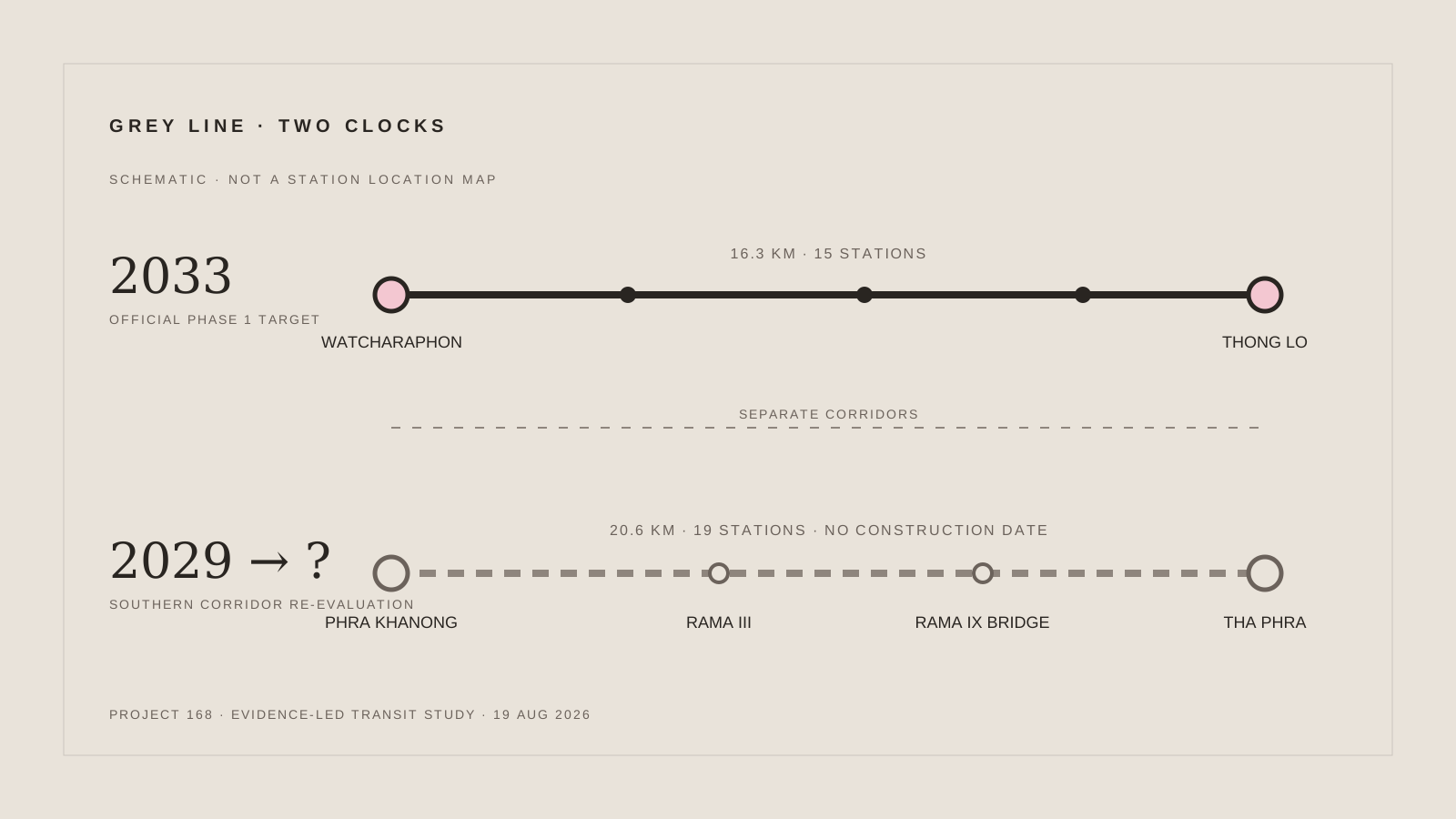
The project now being prepared by MRTA runs from Watcharaphon to Thong Lo; it does not begin there and continue to Rama III. The corridor that matters to One River is a separate, much less mature Phra Khanong–Tha Phra proposal. Its route may pass Rama III and the Rama IX Bridge area, but it has no approved construction date. Our base case places opening in 2040–2043—not 2033.
The short answer
One official programme. One long-range possibility.
The shared colour and old network diagrams make the two corridors feel like one continuous project. They are not at the same stage, under the same timetable or backed by the same approvals.
Watcharaphon → Thong Lo
MRTA lists a 16.3 km elevated straddle monorail with 15 stations. Its current programme targets Cabinet approval in August 2028, construction in July 2030 and operation in October 2033. The feasibility-study consultant procurement is still being prepared.
Phra Khanong → Tha Phra
M-MAP2 classifies this 20.6 km, 19-station concept as Group B: a high-potential route to be re-evaluated in 2029. The published THB 35.602 billion figure is a planning estimate, not an approved budget or award.
Rama III is in the idea, not yet the programme.
Legacy studies trace the southern corridor through Rama III and the Rama IX Bridge area. No current approved station plan establishes a station beside One River. Until the route, stations, funding and delivery agency are reconfirmed, it is future upside—not a present amenity.
The official clock
Phase 1 has dates.
The south has a decision gate.
These are agency milestones, not guarantees. The distinction matters more than the colour on a network map.
- 2021
- The environmental report for Grey Line Phase 1, Watcharaphon–Thong Lo, received approval on 5 May. It was prepared under Bangkok's traffic authority before the later transfer of responsibility.
- 2024
- The Land Traffic Management Commission considered transferring Phase 1 from Bangkok to the Ministry of Transport; MRTA now lists the project among those under implementation preparation.
- 2026
- MRTA's board acknowledged the current programme on 20 January. MRTA says it is preparing procurement for a consultant to conduct a feasibility study.
- 2028
- MRTA's target month for Cabinet construction approval is August 2028.
- 2030
- MRTA's target construction start for Phase 1 is July 2030.
- 2033
- MRTA's target opening for Phase 1 at Thong Lo is October 2033.
- 2029
- Separately, M-MAP2 schedules the Phra Khanong–Tha Phra southern corridor for a fresh suitability review. It does not assign a construction start or opening date.
Our estimate
For Rama III, think in scenarios—not a launch year.
We used the southern corridor's 2029 decision gate, the older 2033–2037 planning band for a possible construction start, and the current Phase 1 programme as schedule evidence. That older band is a scenario input—not a current commitment. The south still carries greater uncertainty: its alignment, stations, river crossing, environmental review, funding and delivery structure remain unsettled.
Open 2037–2039
The 2029 review immediately advances the corridor; feasibility, approvals and procurement overlap; construction begins around 2033–2035. This requires unusually smooth decisions and little redesign.
Open 2040–2043
The route is confirmed after the 2029 review, then moves through a full development cycle. Construction begins around 2036–2039, followed by roughly four to five years of works, systems integration and testing.
2044 or later—or another mode
Competing rail priorities, funding constraints, alignment conflicts or the existing BRT corridor could push the project later, shorten it, change its technology, or prevent the published concept from being built in its current form.
What has to happen first
Five gates stand between a line on a map and a train at Rama III.
- 2029 re-evaluation
Confirm demand, network role and whether the corridor remains a rail priority.
- Route and stations
Freeze the alignment, technology, interchange strategy and treatment of the BRT corridor.
- Environment and land
Complete or update environmental approvals, land requirements and river-crossing design.
- Funding and authority
Assign the delivery agency, approve the investment structure and secure Cabinet authority.
- Procure, build, test
Select contractors or a PPP partner, construct civil and systems works, then commission safely.
What it means for 168
A credible long-horizon bonus—never a current selling claim.
The strongest present transport fact remains the existing BRT service in the Rama III corridor. The southern Grey Line belongs in a long-term city narrative: potentially valuable if delivered, but too early to price into a residence, promise to a buyer or describe as “coming soon.”
The next evidence upgrades are concrete: completion of the 2029 re-evaluation, an identified delivery agency, a revised route and station map, environmental-review status, Cabinet approval, a funded procurement and an executed construction contract. Until then, every station position and opening year is provisional.
Project 168 will update this study when one of those gates moves. That is the useful posture: hopeful about Bangkok's future, precise about what is real today.
Method & sources
A schedule estimate, not an official forecast.
“Official target” means a date published by the responsible agency. “Our estimate” is an independent scenario derived from public decision gates and comparable project-development durations. It is not a government commitment, construction contract, valuation input or guarantee.
The diagram is schematic. It does not fix any station location, walking distance, alignment or interchange.
Primary public records
- MRTA Phase 1 project page — current alignment, 16.3 km, 15 stations, status and 2028/2030/2033 programme.
- Smart EIA Plus record 15338 — Phase 1 approval dated 5 May 2021.
- OTP Land Traffic Management Commission record — 2024 transfer consideration.
- Department of Rail Transport M-MAP2 brochure — southern Group B status, 2029 re-evaluation, 20.6 km, 19 stations and planning cost.
- State Enterprise Policy Office legacy project overview — historical southern-corridor concept through Rama III.
Uncertainty retained
- No approved current station map for the Rama III segment.
- No southern environmental approval, funding approval, procurement or construction contract identified.
- Programme dates can move with policy, design, land, financing and procurement.
- The route may be reconfigured or delivered using a different mode.